What step did the National Recovery Administration (NRA) take to restore the nations economy?
 NRA Blue Eagle poster. This would be displayed in store windows, on packages, and in ads. | |
| Agency overview | |
|---|---|
| Formed | 1933, past the National Industrial Recovery Act (NIRA) |
| Dissolved | May 27, 1935, by court example Schechter Poultry Corp. v. United States |
The National Recovery Administration (NRA) was a prime number bureau established by U.S. president Franklin D. Roosevelt (FDR) in 1933. The goal of the assistants was to eliminate "cut throat competition" past bringing industry, labor, and government together to create codes of "off-white practices" and gear up prices. The NRA was created by the National Industrial Recovery Act (NIRA) and allowed industries to get together and write "codes of fair contest." The codes intended both to help workers set maximum wages and maximum weekly hours, too equally minimum prices at which products could be sold. The NRA too had a two-year renewal lease and was set to expire in June 1935 if non renewed.[1]
The NRA, symbolized past the Blueish Hawkeye, was popular with workers. Businesses that supported the NRA put the symbol in their shop windows and on their packages, though they did not e'er go forth with the regulations entailed. Though membership of the NRA was voluntary, businesses that did not brandish the hawkeye were very often boycotted, making it seem mandatory for survival to many.
In 1935, the U.South. Supreme Court unanimously alleged that the NRA law was unconstitutional, ruling that information technology infringed the separation of powers nether the Usa Constitution. The NRA quickly stopped operations, just many of its labor provisions reappeared in the National Labor Relations Act (Wagner Act), passed after the same year. The long-term result was a surge in the growth and power of unions, which became a core of the New Deal Coalition that dominated national politics for the next three decades.
Background [edit]
As office of the "First New Deal," the NRA was based on the premise that the Great Depression was caused by market place instability and that government intervention was necessary to remainder the interests of farmers, business and labor. The NIRA, which created the NRA, declared that codes of fair competition should be adult through public hearings, and gave the Assistants the power to develop voluntary agreements with industries regarding work hours, pay rates, and cost fixing.[2] The NRA was put into operation by an executive club, signed the same 24-hour interval as the passage of the NIRA.
New Dealers who were function of the administration of President Franklin D. Roosevelt saw the close analogy with the earlier crisis handling the economics of World War I. They brought ideas and experience from the government controls and spending of 1917–xviii.
In his June 13, 1933 "Statement on the National Industrial Recovery Human activity," President Roosevelt described the spirit of the NRA: "On this thought, the starting time part of the NIRA proposes to our industry a great spontaneous cooperation to put millions of men back in their regular jobs this summertime."[3] [4] He further stated, "Just if all employers in each merchandise now ring themselves faithfully in these modern guilds—without exception—and agree to act together and at once, none will be hurt and millions of workers, so long deprived of the right to earn their bread in the sweat of their labor, can raise their heads once more. The challenge of this law is whether we can sink selfish interest and nowadays a solid front against a common peril."[3] [4]
Inception [edit]

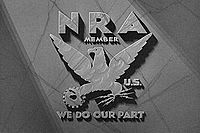
The film manufacture supported the NRA
The beginning managing director of the NRA was Hugh Southward. Johnson, a retired United states Regular army full general who had been in charge of supervising the wartime economy in 1917-1918. He was named Fourth dimension magazine'southward "Man of the Twelvemonth" in 1933. Johnson saw the NRA as a national crusade designed to restore employment and regenerate industry.
Johnson called on every concern establishment in the nation to take a stopgap "blanket code": a minimum wage of between xx and 45 cents per hour, a maximum workweek of 35 to 45 hours, and the abolition of kid labor. Johnson and Roosevelt contended that the "blanket code" would enhance consumer purchasing power and increase employment.
Historian Clarence B. Carson noted:
At this moment in time from the early on days of the New Deal, information technology is difficult to recapture, even in imagination, the heady enthusiasm among a goodly number of intellectuals for a government planned economic system. So far as can now be told, they believed that a bright new solar day was dawning, that national planning would upshot in an organically integrated economy in which everyone would joyfully work for the common good, and that American guild would be freed at concluding from those antagonisms arising, every bit General Hugh Johnson put it, from "the murderous doctrine of savage and wolfish individualism, looking to dog-swallow-canis familiaris and devil have the hindmost.[v]

Goal [edit]
The negotiations of a code for the bituminous coal industry came against the groundwork of a speedily swelling union, the United Mine Workers headed past John L. Lewis and an unstable truce in the Pennsylvania coal fields. The NRA tried to get the principals to compromise with a national lawmaking for a decentralized industry in which many companies were anti-spousal relationship, sought to keep wage differentials, and tried to escape the collective bargaining provisions of department 7A. Agreement among the parties was finally reached only subsequently the NRA threatened that it would impose a code. The code did not constitute price stabilization, nor did it resolve questions of industrial self-government versus governmental supervision or of centralization versus local autonomy, but it fabricated dramatic changes in abolishing child labor, eliminating the compulsory scrip wages and company store, and establishing fair trade practices. It paved the way for an important wage settlement.[6]
Price controls [edit]
In early on 1935 the new chairman, Samuel Dirt Williams, announced that the NRA would terminate setting prices, but businessmen complained. Chairman Williams told them evidently that, unless they could testify it would harm business, NRA was going to put an end to price command. Williams said, "Greater productivity and employment would consequence if greater price flexibility were attained."[7] Of the ii,000 businessmen on hand probably 90% opposed Mr. Williams' aim, reported Fourth dimension magazine: "To them a guaranteed price for their products looks like a royal route to profits. A fixed price above toll has proved a lifesaver to more one inefficient producer."[7] Still, it was also argued NRA's price control method promoted monopolies.[8]
The concern position was summarized by George A. Sloan, caput of the Cotton Textile Code Authority:
Maximum hours and minimum wage provisions, useful and necessary as they are in themselves, do not prevent price demoralization. While putting the units of an industry on a fair competitive level insofar as labor costs are concerned, they do not foreclose destructive price cutting in the auction of commodities produced, any more than a fixed price of cloth or other element of cost would prevent information technology. Destructive competition at the expense of employees is lessened, but information technology is left in total swing against the employer himself and the economical soundness of his enterprise....But if the partnership of industry with Regime which was invoked by the President were terminated (as we believe it will not be), then the spirit of cooperation, which is one of the all-time fruits of the NRA equipment, could not survive.[vii]
The Bluish Eagle [edit]
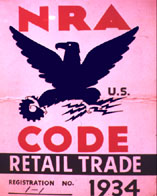
The Blue Eagle was a symbol used in the United States by companies to evidence compliance with the National Industrial Recovery Act. To mobilize political back up for the NRA, Johnson launched the "NRA Blue Eagle" publicity entrada to boost his bargaining strength to negotiate the codes with business and labor.[9] [ten] [11]
Many sources credit advertising art director Charles T. Coiner with the design.[12] [13] [14] [15] According to a few sources, however, it was sketched by Johnson, based on an idea used by the War Industries Lath during Globe State of war I.[16] [11] The eagle holds a gear, symbolizing industry, in its right talon, and bolts of lightning in its left talon, symbolizing power.[17]
All companies that accustomed President Franklin D. Roosevelt'southward Re-employment Agreement or a special Code of Fair Competition were permitted to brandish a poster showing the Blueish Eagle together with the announcement, "NRA Member. We Exercise Our Part."[16] [10] [11] Consumers were exhorted to buy products and services but from companies displaying the Blueish Hawkeye imprint.[sixteen] [11] According to Johnson,
When every American housewife understands that the Blue Eagle on everything that she permits into her dwelling house is a symbol of its restoration to security, may God accept mercy on the man or group of men who endeavor to trifle with this bird.[eighteen]
Critics [edit]
Well-nigh businesses adopted the NRA without complaint, simply Henry Ford was reluctant to join.[19]
The National Recovery Review Board, headed by noted criminal lawyer Clarence Darrow, a prominent liberal, was fix by President Roosevelt in March 1934 and abolished by him that same June. The board issued three reports highly critical of the NRA from the perspective of small business organisation, charging the NRA with fostering cartels. The Darrow board, influenced by Justice Louis D. Brandeis, wanted instead to promote competitive commercialism.[twenty]
Representing big business concern, the American Liberty League, 1934–twoscore, was run by leading industrialists who opposed the liberalism of the New Deal. Regarding the controversial NRA, the League was ambivalent. Jouett Shouse, the League president, commented that "the NRA has indulged in unwarranted excesses of attempted regulation"; on the other, he added that "in many regards [the NRA] has served a useful purpose."[21] Shouse said that he had "deep sympathy" with the goals of the NRA, explaining, "While I experience very strongly that the prohibition of kid labor, the maintenance of a minimum wage and the limitation of the hours of work belong under our form of government in the realm of the affairs of the different states, withal I am entirely willing to concord that in the case of an overwhelming national emergency the Federal Authorities for a express period should be permitted to presume jurisdiction of them."[22]
The NRA in practice [edit]

Chart three: Manufacturing employment in the United states of america from 1920 to 1940
The NRA negotiated specific sets of codes with leaders of the nation's major industries; the most important provisions were anti-deflationary floors below which no company would lower prices or wages, and agreements on maintaining employment and production. In a remarkably short time, the NRA won agreements from virtually every major manufacture in the nation. Co-ordinate to some conservative economists, the NRA increased the cost of doing business by 40 percent.[23] Donald Richberg, who soon replaced Johnson as the head of the NRA said:
There is no selection presented to American business betwixt intelligently planned and uncontrolled industrial operations and a return to the gold-plated chaos that masqueraded as "rugged individualism."...Unless industry is sufficiently socialized by its private owners and managers so that great essential industries are operated under public obligation appropriate to the public interest in them, the accelerate of political control over private industry is inevitable.[24]
By the fourth dimension it concluded in May 1935, industrial production was 22% higher than in May 1933.[ citation needed ]
Specific industries [edit]
Pennock (1997) shows that the rubber tire manufacture faced debilitating challenges, more often than not brought about past changes in the manufacture'due south retail construction and exacerbated by the Depression. Segments of the industry attempted to use the NRA codes to solve these new issues and stabilize the tire market, but the tire manufacturing and tire retailing codes were patent failures. Instead of leading to cartelization and higher prices, which is what about scholars assume the NRA codes did, the tire industry codes led to fifty-fifty more fragmentation and price cut.[25]
Alexander (1997) examines the macaroni industry and concludes that cost heterogeneity was a major source of the "compliance crisis" affecting a number of NRA "codes of fair competition" that were negotiated by industries and submitted for government approval nether the National Manufacture Recovery Act of 1933. The statement boils down to assumptions that progressives at the NRA immune majority coalitions of small, high-toll firms to impose codes in heterogeneous industries, and that these codes were designed by the high-cost firms nether an ultimately erroneous conventionalities that they would be enforced by the NRA.[26]
Storrs (2000) says the National Consumers' League (NCL) had been instrumental in the passage and legal defense of labor legislation in many states since 1899. Women activists used the New Deal opportunity to gain a national forum. General Secretary Lucy Randolph Mason and her league relentlessly lobbied the NRA to make its regulatory codes just and fair for all workers and to eliminate explicit and de facto discrimination in pay, working conditions, and opportunities for reasons of sex, race, or wedlock condition. Even after the demise of the NRA, the league continued campaigning for collective bargaining rights and fair labor standards at both federal and country levels.[27]
Enforcement [edit]

About 23 1000000 people were employed under the NRA codes. Withal, violations of codes became mutual and attempts were made to use the courts to enforce the NRA. The NRA included a multitude of regulations imposing the pricing and production standards for all sorts of goods and services. Individuals were arrested for non complying with these codes. For example, 1 small man of affairs was fined for violating the "Tailor's Code" past pressing a adjust for 35 rather than NRA required 40 cents. Roosevelt critic John T. Flynn, in The Roosevelt Myth (1944), wrote:
The NRA was discovering it could not enforce its rules. Black markets grew upwardly. Simply the virtually violent law methods could procure enforcement. In Sidney Hillman's garment manufacture the code authority employed enforcement police force. They roamed through the garment district like tempest troopers. They could enter a man's factory, ship him out, line upward his employees, field of study them to infinitesimal interrogation, take over his books on the instant. Dark work was forbidden. Flying squadrons of these private coat-and-suit police went through the district at nighttime, battering down doors with axes looking for men who were committing the criminal offence of sewing together a pair of pants at night. But without these harsh methods many code authorities said in that location could be no compliance because the public was not back of it.
The NRA was famous for its bureaucracy. Announcer Raymond Clapper reported that between 4,000 and 5,000 business practices were prohibited past NRA orders that carried the force of law, which were contained in some iii,000 administrative orders running to over ten meg pages, and supplemented by what Clapper said were "innumerable opinions and directions from national, regional and lawmaking boards interpreting and enforcing provisions of the act." There were also "the rules of the code government, themselves, each having the force of police and affecting the lives and conduct of millions of persons." Clapper concluded: "It requires no imagination to appreciate the difficulty the business organization human being has in keeping informed of these codes, supplemental codes, lawmaking amendments, executive orders, administrative orders, part orders, interpretations, rules, regulations and obiter dicta."[28]
Judicial review [edit]
On 27 May 1935, in the courtroom case of Schechter Poultry Corp. v. U.s.a., the Supreme Courtroom held the mandatory codes section of NIRA unconstitutional,[29] because it attempted to regulate commerce that was non interstate in grapheme, and that the codes represented an unacceptable delegation of power from the legislature to the executive. Chief Justice Charles Evans Hughes wrote for a unanimous Court in invalidating the industrial "codes of off-white competition" which the NIRA enabled the President to issue. The Court held that the codes violated the United States Constitution's separation of powers as an impermissible delegation of legislative power to the executive co-operative. The Courtroom also held that the NIRA provisions were in excess of congressional ability under the Commerce Clause.[30]
The Courtroom distinguished between straight effects on interstate commerce, which Congress could lawfully regulate, and indirect, which were purely matters of state law. Though the raising and sale of poultry was an interstate industry, the Courtroom plant that the "stream of interstate commerce" had stopped in this instance: Schechter's slaughterhouses bought chickens only from intrastate wholesalers and sold to intrastate buyers. Whatsoever interstate effect of Schechter was indirect, and therefore beyond federal reach.[31]
Specifically, the Courtroom invalidated regulations of the poultry manufacture promulgated nether the authority of the National Industrial Recovery Act of 1933, including cost fixing and wage fixing, too as requirements regarding a whole shipment of chickens, including unhealthy ones, which led to the case becoming known as "the sick chicken instance." The ruling was one of a series which overturned some New Deal legislation between January 1935 and January 1936.
Subsequent to the determination, the residual of Title I was extended until Apr 1, 1936, by articulation resolution of Congress (49 Stat. 375), June 14, 1935, and NRA was reorganized by E.O. 7075, June 15, 1935, to facilitate its new role as a promoter of industrial cooperation and to enable it to produce a series of economic studies,[29] which the National Recovery Review Lath was already doing.[32] Many of the labor provisions reappeared in the Wagner Human action of 1935.
Legacy [edit]
The NRA tried to finish the Corking Depression by organizing thousands of businesses under codes drawn up by trade associations and industries. Hugh Johnson proved charismatic in setting upwardly publicity that glorified his new NRA. Johnson was recognized for his efforts when Time named him Human being of the Yr of 1933—choosing him instead of FDR.[33]
By 1934 the enthusiasm that Johnson had and then successfully created had faded. Johnson was faltering desperately, which historians accredit to the profound contradictions in NRA policies, compounded past Johnson's heavy drinking on the chore. Large business and labor unions both turned hostile.[34] [35] [36]1
According to biographer John Ohl (every bit summarized by reviewer Lester 5. Chandler):
Johnson'due south priorities became evident nigh immediately. In the prescription, "Self regulation of manufacture nether government supervision" the emphasis was to exist on maximum freedom for business organization to formulate its ain rules with a minimum of authorities supervision. Consumer protection and the interests of labor were of decidedly bottom importance. To induce business organisation to formulate and abide by codes of fair competition Johnson was willing to disregard almost any type of price fixing, restriction of production, limitation of productive capacity, and other types of anti-competitive practices....even with the do good of a more efficient and diplomatic management and a more tolerant Supreme Courtroom the NRA probably would not take survived much longer. It'south inherent conflicts and inconsistencies were just besides potent.[37]
Historian William E. Leuchtenburg argued in 1963:
The NRA could boast some considerable achievements: it gave jobs to some two one thousand thousand workers; it helped stop a renewal of the deflationary spiral that had almost wrecked the nation; it did something to improve business ethics and acculturate competition; information technology established a national design of maximum hours and minimum wages; and information technology all just wiped out kid labor and the sweatshop. But this was all information technology did. Information technology prevented things from getting worse, but it did little to speed recovery, and probably actually hindered it by its support of restrictionism and price raising. The NRA could maintain a sense of national interest against private interests only so long equally the spirit of national crisis prevailed. As it faded, restriction-minded businessmen moved into a decisive position of authority. By delegating power over price and production to merchandise associations, the NRA created a series of individual economic governments.[38]
According to historian Ellis Hawley in 1976:[39]
at the easily of historians the National Recovery Administration of 1933-35 has fared badly. Cursed at the time, it has remained the image of political aberration, illustrative of the pitfalls of "planning" and deplored both for hampering recovery and delaying 18-carat reform.
See as well [edit]
- Job creation program
References [edit]
- ^ "Archived copy". Archived from the original on 2012-01-xiv. Retrieved 2011-07-05 .
{{cite spider web}}: CS1 maint: archived re-create as championship (link) - ^ National Recovery Assistants. The Columbia Encyclopedia, Sixth Edition. 2001-07
- ^ a b Franklin D. Roosevelt Presidential Library and Museum – Our Documents
- ^ a b Franklin D. Roosevelt Statement on North.I.R.A.
- ^ Carson, Clarence B. The Relics of Intervention part 4. New Bargain Collective Planning
- ^ James P. Johnson, "Drafting the NRA Code of Off-white Competition for the Bituminous Coal Industry," Journal of American History, Vol. 53, No. 3 (December., 1966), pp. 521–41 in JSTOR
- ^ a b c "Dollar Men & Prices". Time. Jan 21, 1935. Archived from the original on March 4, 2007.
- ^ "The National Recovery Administration | Economical History Services". Archived from the original on 2007-02-20. Retrieved 2005-12-12 .
- ^ Schlesinger
- ^ a b Johnson, Hugh Southward. The Blue Eagle From Egg to Globe. New York: Doubleday, Doran & Company, 1935.
- ^ a b c d Himmelberg, Robert. The Origins of the National Recovery Assistants. 2d paperback ed. New York: Fordham University Press, 1993. ISBN 0-8232-1541-v
- ^ "Charles T. Coiner, 91, Ex-Art Chief at Ayer". The New York Times. August sixteen, 1989.
- ^ Julia Cass (August 14, 1989). "Charles T. Coiner, 91, Painter And Noted Advertizing Designer". Philadelphia Inquirer. Archived from the original on May 21, 2015.
- ^ "Charles T. Coiner". James A. Michener Art Museum. Archived from the original on September 3, 2004. Retrieved January 23, 2012.
- ^ "Charles Coiner Papers". Syracuse University Library. Retrieved January 23, 2012.
- ^ a b c Schlesinger, Jr., Arthur M. The Age of Roosevelt, Vol. 2: The Coming of the New Deal. Paperback ed. New York: Mariner Books, 2003. (Originally published 1958.) ISBN 0-618-34086-6
- ^ Krugner, Dorothy (January 15, 2009). "NRA buttons (from the National Button Society, United states of america)". Bead&Button. Kalmbach Publishing. Archived from the original on August 7, 2011. Retrieved March 6, 2010.
- ^ Hamby, Alonzo L. For the Survival of Democracy. New York: Simon and Schuster, 1994, p. 164.
- ^ Dan Cooper and Brian Grinder, "We Do Our Office: Henry Ford and the NRA," Financial History, Bound 2009, Issue 94, pp. x–35
- ^ Sniegoski, Stephen J. "The Darrow Board and the Downfall of the NRA". Continuity. 1990 (xiv): 63–83.
- ^ Ronen Shamir, Managing Legal Incertitude: Elite Lawyers in the New Bargain (1995) p. 22
- ^ Shamir, pp. 24–25
- ^ Reed, Lawrence W. Nifty Myths of the Great Depression Mackinac Center for Public Policy.
- ^ Arthur Meier Schlesinger, Jr. The Coming of the New Deal, Houghton Mifflin Books (2003), p. 115.
- ^ Pamela Pennock, "The National Recovery Administration and the Rubber Tire Manufacture, 1933–1935." Business History Review," 1997 71(4): 543–68 in JSTOR
- ^ Alexander, Barbara J. (1997). "Failed Cooperation in Heterogeneous Industries under the National Recovery Administration". Journal of Economic History. 57 (two): 322–44. doi:10.1017/s0022050700018465. JSTOR 2951040.
- ^ Landon R. Storrs, Civilizing Capitalism: The National Consumers' League, Women'southward Activism, and Labor Standards in the New Deal Era, (U of North Carolina Printing, 2000) online edition
- ^ Clapper in Washington Post, Dec. four, 1934, quoted in Best, 79–80 (1991).
- ^ a b National Recovery Administration Archived 2011-07-22 at the Wayback Auto, Authorisation Tape (Corporate Body) U.s., Committee on Descriptive Standards, International Council on Archives. Accessed xi Nov 2010
- ^ Tim McNeese and Richard Jensen, The Smashing Low 1929–1938 (2010) p. ninety
- ^ Steven Emanuel and Lazar Emanuel, Constitutional Law (2008) p. 31
- ^ Executive Guild 6632 Creating The National Recovery Review Lath. March 7, 1934
- ^ run into TIME story
- ^ William H. Wilson, "How the chamber of commerce viewed the NRA: A re-examination." Mid America 42 (1962): 95-108.
- ^ Bernard Bellush, The Failure of the NRA (1975).
- ^ Martin, Madam Secretary: Frances Perkins, (1976) p. 331.
- ^ Lester V. Chandler, review of Ohl, Hugh Due south. Johnson and the New Deal in Journal of Economic History (March 1987) 47: 286 DOI:10.1017/s0022050700047951
- ^ William E. Leuchtenburg, Franklin D. Roosevelt and the New Deal, 1932–1940 (1963) p. 69.
- ^ Ellis Hawley, review of Bernard Balush, The Failure of the NRA, in American Historical Review 81#4 1976 p. 995.
Bibliography [edit]
- Alexander, Barbara (1994). "The Bear on of the National Industrial Recovery Deed on Cartel Formation and Maintenance Costs". Review of Economics and Statistics. 76 (2): 245–54. doi:10.2307/2109879. JSTOR 2109879.
- All-time; Gary Dean. Pride, Prejudice, and Politics: Roosevelt Versus Recovery, 1933–1938. (1991) online edition ISBN 0-275-93524-8
- Brand, Donald R. (1983). "Corporatism, the NRA, and the Oil Industry". Political Scientific discipline Quarterly. 98 (1): 99–118. doi:10.2307/2150207. JSTOR 2150207. Uses corporatism model to explore the struggle between contained oil producers and major oil producers over production and price controls.
- Burns, Arthur Robert (1934). "The Showtime Stage of the National Industrial Recovery Act, 1933". Political Scientific discipline Quarterly. 49 (2): 161–94. doi:x.2307/2142881. JSTOR 2142881.
- Dearing, Charles L. et al. The ABC of the NRA, (1934) 200 pgs. online edition
- Hawley, Ellis W. (1968). The New Deal and the Problem of Monopoly. Princeton Upwards. ISBN0-8232-1609-8. The classic scholarly history
- Hawley, Ellis W. (1975). "The New Deal and Business organization". In Bremner, Robert H.; Brody, David (eds.). The New Deal: The National Level. Ohio Land University Press. pp. 50–82.
- Johnson; Hugh Due south. The Blueish Hawkeye, from Egg to Globe 1935, memoir by NRA manager online edition
- Leuchtenburg, William E. Franklin D. Roosevelt and the New Deal, 1932–1940 (1963) online
- Leuchtenburg, William E. "The New Deal and the analogue of war." in Change and Continuity in Twentieth-Century America (1964) 1: 81-143.
- Lyon, Leverett South., Paul T. Homan, Lewis L. Lorwin, George Terborgh, Charles 50. Dearing, Leon C. Marshall; The National Recovery Assistants: An Analysis and Appraisal The Brookings Establishment, 1935. in-depth analysis by economists, online edition
- Mazzocco, Dennis Due west. "Radio'due south new bargain: The NRA and US broadcasting, 1933–1935." Journal of Radio Studies 12.1 (2005): 32-46.
- Ohl, John Kennedy (1985). Hugh S. Johnson and the New Deal . ISBN0-87580-110-two. Academic biography
- Schlesinger, Arthur Meier (1958). The Coming of the New Deal. pp. 87–176. online
- Skocpol, Theda, and Kenneth Finegold. "State chapters and economic intervention in the early New Bargain." Political Scientific discipline Quarterly 97.2 (1982): 255-278. online
- Sniegoski, Stephen J. (1990). "The Darrow Board and the Downfall of the NRA". Continuity. 1990 (fourteen): 63–83. ISSN 0277-1446.
- Taylor, Jason E. (2007). "Cartel Code Attributes and Cartel Performance: An Industry‐Level Analysis of the National Industrial Recovery Act". Journal of Constabulary and Economics. 50 (three): 597–624. doi:x.1086/519808.
External links [edit]
- 1933 Promotional Video for National Recovery Administration
- Commodity on the NRA from EH.Net's Encyclopedia
- Archive of The Bird Did Its Part past T.H. Watkins
- Jimmy Durante singing a promotion for the NRA
campbellfortallen.blogspot.com
Source: https://en.wikipedia.org/wiki/National_Recovery_Administration
0 Response to "What step did the National Recovery Administration (NRA) take to restore the nations economy?"
Post a Comment